Package the controls before clients get frontier cyber models.
Consultiply's independent MSP read of Google's Gemini 4 Argon Fairwind gate: trusted cyber defenders first, intro pricing, and the controls / sandboxes / named owners / runtime A/B/E packaging play before GA.
Published October 1, 2026 · ~8 min read
What shipped
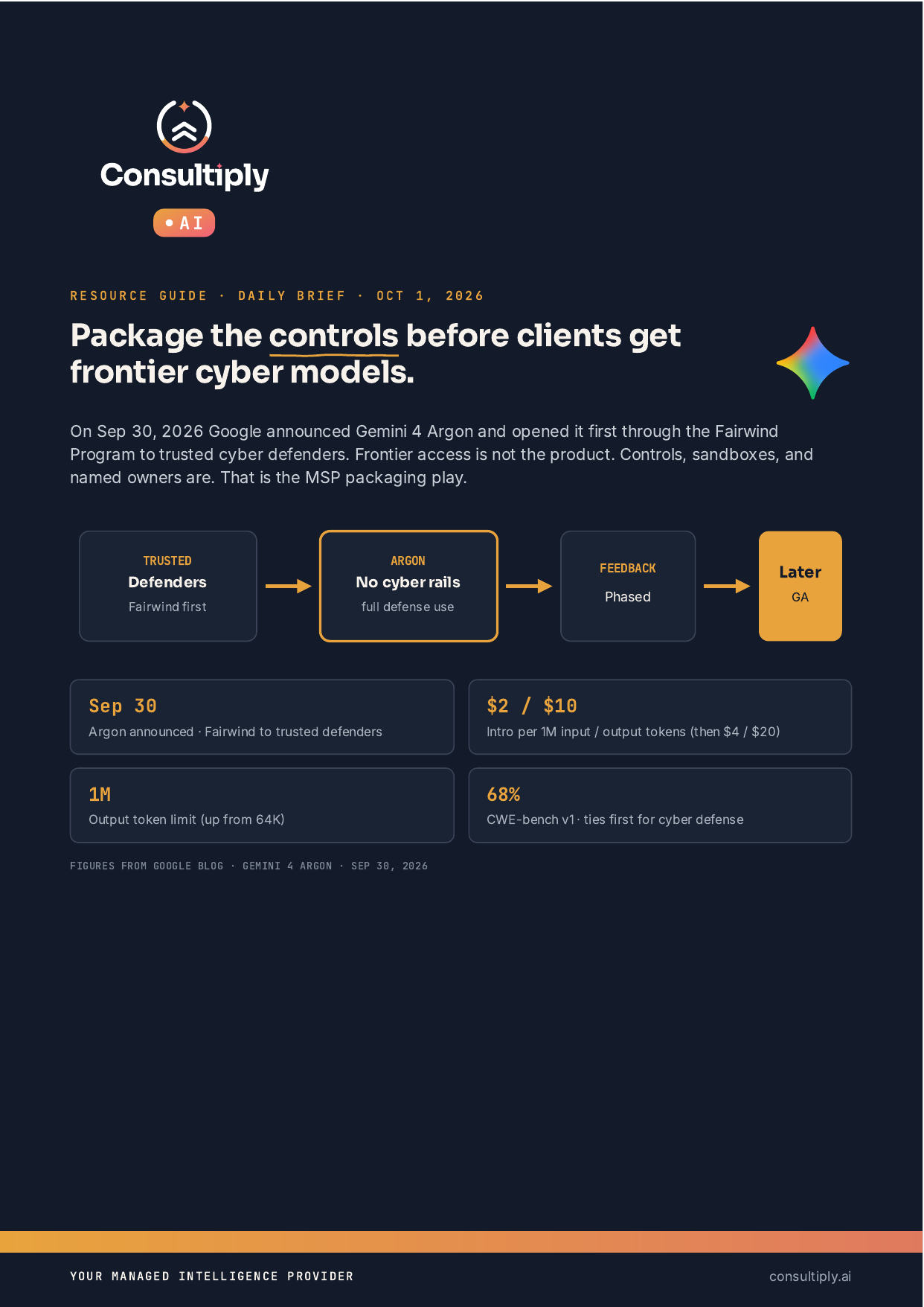
On September 30, 2026, Google announced Gemini 4 Argon, its next frontier model. Per Google's own blog, Argon is rolling out first to a set of trusted cyber defenders through the Fairwind Program. Google DeepMind's X post the same day framed the same gate: complex workflows across coding, enterprise knowledge work, and cybersecurity defense, for trusted testers via Fairwind.
Google says Argon delivers frontier performance in real-world software engineering, enterprise knowledge work such as legal and finance, and cybersecurity defense. The Verge reported the limited first wave and noted Google is strengthening frontier safeguards before broader rollout, including defenses against misuse and prompt injection and monitoring for misalignment.
Safely releasing frontier capabilities at this level, Google writes, requires a phased approach. The company says it is actively engaged in the U.S. government's voluntary process for pre-release model access while it gradually expands access. Feedback from early testers is meant to harden guardrails before Argon reaches developers, enterprises, and consumers, starting with paid API customers and Google AI Ultra subscribers (vendor claims).
Access, pricing, and cyber posture (vendor claims)
Introductory API pricing is listed at $2 per million input tokens and $10 per million output tokens, with cached input tokens at 95% off the input token price. After the introductory period, Google says $4 per 1M input and $20 per 1M output will apply.
To support longer, more complex use cases, Google is expanding Argon's output token limit to 1M tokens, up from the previous 64K tokens (vendor claim).
For trusted defenders and Google's own internal teams, Google says it will release Argon without cyber guardrails so they can use full frontier-level cybersecurity defense capabilities. Argon can autonomously find, validate, and patch critical software vulnerabilities (vendor claim). Wiz is already using Argon through its Scan for Good initiative; Google cites an early demonstration where the model uncovered a critical vulnerability exposing sensitive personal information across healthcare software used by hospitals worldwide that previous frontier models had missed (vendor claim).
On CWE-bench v1, which evaluates remediating security vulnerabilities, Google says Argon ties for first place with a top score of 68%. Other vendor-reported benchmarks in the same post include DeepSWE v1.1 at 77.9% (SOTA), AutomationBench at 51.3% (#1), and LVBench at 91.7% (SOTA). None of these figures were measured by Consultiply.
Before broad availability, Google lists four safeguard workstreams: defending against misuse (including CBRN), defending against prompt injection (Gray Swan IPI leading per Google), monitoring for misalignment via chain-of-thought and action monitoring, and hardening sandboxed environments by isolating and sealing them before high-risk training or evaluations.
What this means for MSP operators
Frontier access is not the product. Controls, sandboxes, and named owners are. Clients will hear "Gemini 4 Argon" and ask for cyber capability. Your offer is the packaging layer that sits in front of that capability.
Sell the gate, not the model.
Fairwind opens Argon to trusted cyber defenders first, without cyber guardrails for that cohort. Map which client roles would even qualify as defender use cases before anyone demos full-capability cyber tooling.
Own named humans per use case.
Phased release plus U.S. voluntary pre-release engagement means accountability is part of the story. Name who approves defender workloads, who reviews findings, and who can revoke access.
Package hardened sandboxes.
Google is hardening sandboxed environments for high-risk runs. Translate that into client SOWs: isolated execution for defense workloads, sealed eval environments, and no production writes without human sign-off.
Ship runtime approve / block / escalate.
Misuse, CBRN refusal, prompt-injection posture, and misalignment monitors are Google's roadmap language. Your product is the runtime A/B/E path clients invoke when an agent finds a vuln, drafts a patch, or asks to touch a live system.
Quote intro vs. post-intro rates.
$2 / $10 per 1M intro versus $4 / $20 later, plus 95% cache off on input, are the vendor numbers to put on a pricing watch list. Margin still sits in governance delivery, not token arbitrage.
Offer moves this week
Build a Fairwind-style readiness worksheet.
Named owners, allowed defense use cases, sandbox rules, and approve / block / escalate owners before any client asks for Argon-class cyber access.
Pilot one defender client.
Prefer accounts that already run vuln discovery or patching programs. Sell controls packaging as a paid engagement while Fairwind learns and GA is still later.
Update SOW language for frontier cyber models.
Who owns kill switches, who can pause agent paths, how healthcare or other high-sensitivity findings get escalated, and where sandboxed runs are required.
Watch the expand path.
Google says expansion goes to developers, enterprises, and consumers after phased Fairwind learning, starting with paid API and AI Ultra. Treat today's gate as the packaging window, not the finish line.
Numbers table
Figures below appear in Google's Blog and Google DeepMind's X post. None were measured by Consultiply.
| Claim | What was measured | Status |
|---|---|---|
| Fairwind gate / announce date | September 30, 2026; trusted cyber defenders first via Fairwind. From Google Blog and Google DeepMind X post. | Vendor claim |
| Intro token pricing | $2 / $10 per 1M input / output; cached input 95% off. Vendor claim (Google Blog). | Vendor claim |
| Post-intro token pricing | $4 / $20 per 1M input / output. Vendor claim (Google Blog). | Vendor claim |
| Output token limit | 1M (up from 64K). Vendor claim (Google Blog). | Vendor claim |
| CWE-bench v1 | 68% tie for first. Vendor claim (Google Blog). | Vendor claim |
| DeepSWE v1.1 | 77.9% SOTA. Vendor claim (Google Blog). | Vendor claim |
| AutomationBench | 51.3% #1. Vendor claim (Google Blog). | Vendor claim |
| LVBench | 91.7% SOTA. Vendor claim (Google Blog). | Vendor claim |
This guide is Consultiply's independent analysis of Google's own announcement, translated for MSP operators. It is not affiliated with or endorsed by Google.
Reviewed, not run by us.
This guide is Consultiply's independent analysis of Google's own announcement, translated for MSP operators. It is not affiliated with or endorsed by Google. Official Google Blog Gemini 4 Argon announcement (Sep 30, 2026) →
